 English
 French
Hydraulic Breaker vs Crusher Bucket: Optimal Site Solutions
Picking between a hydraulic breaker and a crusher bucket comes down to what you actually need the material to become. I’ve watched contractors agonize over this decision, and the ones who get it right tend to think backwards from the end result. If you need rubble gone and don’t care about keeping it, that’s one tool. If you want that same rubble turned into something you can sell or reuse, that’s another. The difference in project economics can be substantial, sometimes making or breaking the profitability of a demolition job.
How Each Attachment Actually Works
Hydraulic breakers and crusher buckets approach material reduction from opposite directions. A hydraulic breaker function delivers percussive force through a chisel, hammering into hard surfaces until they fracture. A crusher bucket mechanism takes a completely different path, using jaw or rotor systems to compress material between hardened plates. The breaker breaks things apart. The crusher bucket performs primary crushing and material size reduction by squeezing debris into smaller, more uniform pieces.
Both qualify as essential excavator attachments, but they solve different problems.
| Feature | Hydraulic Breaker | Crusher Bucket |
|---|---|---|
| Mechanism | Percussive impact | Compression, shearing, or grinding |
| Primary Action | Fracturing, splitting, breaking | Crushing, pulverizing, sizing |
| Material Type | Hard rock, reinforced concrete, asphalt | Concrete, brick, asphalt, natural rock, mixed debris |
| Output | Irregular fragments, large pieces | Sized aggregate, reusable fill |
| Control | Precise, targeted demolition | Bulk material processing |
Breaking Things Down With Hydraulic Breakers
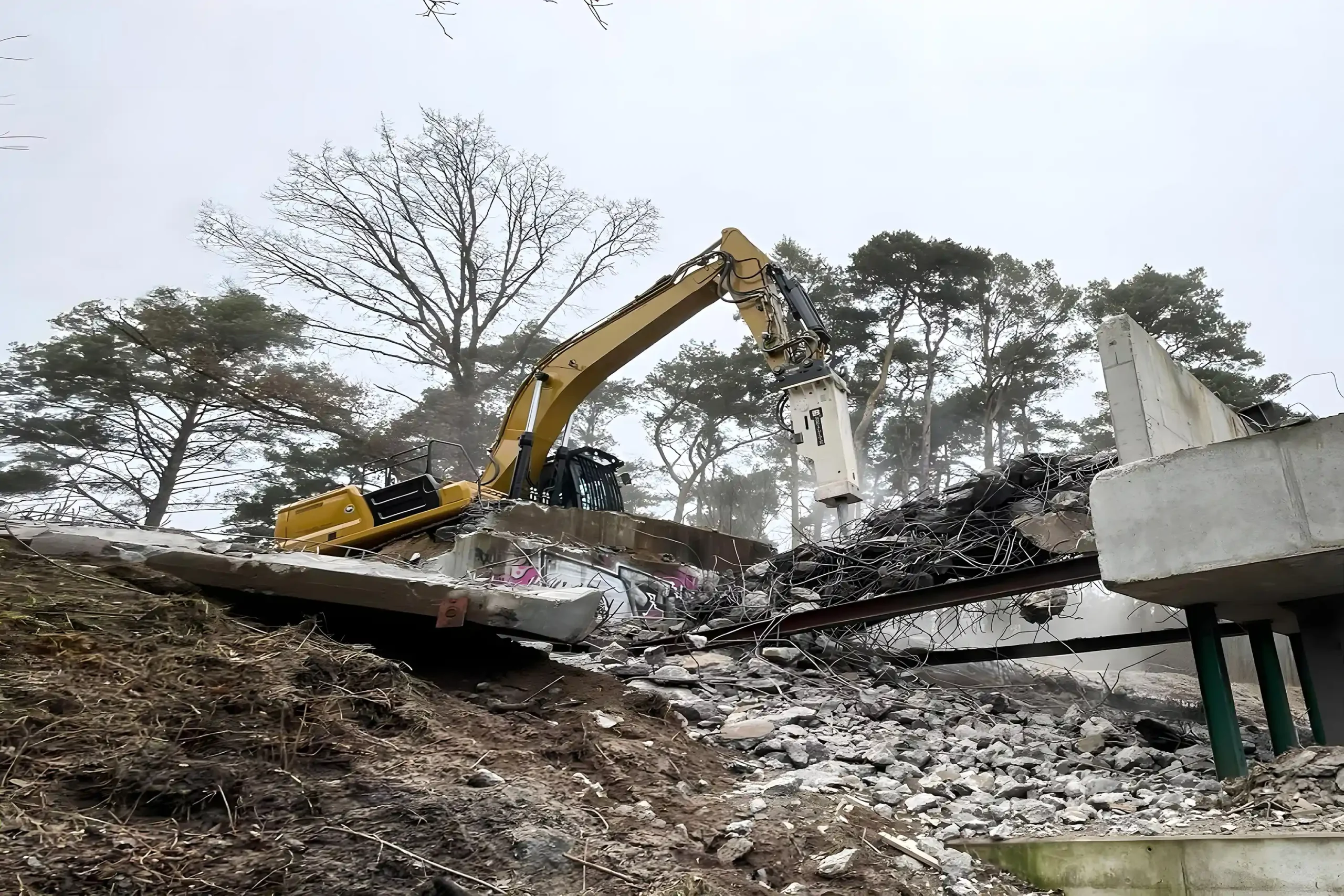
Hydraulic breakers handle heavy-duty demolition and rock excavation by converting hydraulic pressure into raw kinetic energy. That impact energy drives a hardened chisel into concrete breaking and rock breaking applications with remarkable efficiency. The material doesn’t gradually wear away. It fractures along stress lines, often splitting into large irregular chunks.
BEILITE hydraulic breakers span a wide range of carrier sizes, from the BLT-40 designed for compact 0.5-1.2 ton excavators up to the BLT-165 built for 33-38 ton machines. Each model delivers calibrated force and frequency matched to its intended application weight class.
Turning Debris Into Usable Material With Crusher Buckets
Crusher buckets exist for on-site crushing and material processing where the goal isn’t just demolition but transformation. A jaw crusher bucket mounts directly to your excavator and processes construction waste recycling materials into aggregate production right where the debris sits.
The real value shows up in the numbers. Hauling demolished concrete to a landfill costs money. Processing it on-site into graded fill eliminates that expense and creates something you can actually use. Most units allow output particle size adjustment, so you can dial in the aggregate specification your project requires.
Measuring Real World Performance
Evaluating operational efficiency means looking at productivity metrics, material throughput, and cycle time within your specific job site constraints. Neither attachment performs in isolation. Both depend heavily on proper excavator compatibility, adequate hydraulic flow, and correct operating pressure to deliver their rated performance.
| Metric | Hydraulic Breaker | Crusher Bucket |
|---|---|---|
| Productivity | High for specific, hard material breakdown | High for bulk material processing and sizing |
| Material Handling | Requires secondary equipment for material removal | Processes and loads material in one step |
| Cycle Time | Fast for individual breaks | Continuous processing once loaded |
| Mobility | Excellent, moves with excavator | Excellent, processes material where it lies |
| Setup Time | Minimal attachment change | Minimal attachment change |
Matching the Tool to the Material
Material hardness and your desired output drive this decision more than anything else. Hydraulic breakers make sense when you need precise demolition of large monolithic structures or dense rock formations. The focused impact handles reinforced concrete and primary rock effectively because it concentrates force on a small area.
Crusher buckets work best for processing demolition debris and natural rock into graded aggregate quality. They excel at concrete recycling and producing usable fill material without leaving the site. That means less dependence on external aggregate suppliers and more control over your material costs.
What Happens Around the Attachment
Site logistics shift dramatically depending on which tool you choose. Crusher buckets deliver significant waste volume reduction and on-site recycling benefits that translate directly to lower transport costs and easier environmental regulations compliance. The tradeoff involves dust generation, which requires serious dust control measures to manage properly.
Hydraulic breakers produce less fine particulate matter but create their own challenges around noise levels and vibration reduction concerns. Urban projects often face stricter limits on both, which can constrain operating hours or require additional mitigation measures.
Understanding the Financial Picture
The financial implications extend beyond the purchase price to include capital investment, ongoing operational costs, and realistic return on investment (ROI) projections. Maintenance requirements and wear parts consumption differ significantly between these tools. Factor in fuel consumption and equipment lifespan to calculate your actual cost per ton of processed material.
| Cost Factor | Hydraulic Breaker | Crusher Bucket |
|---|---|---|
| Initial Investment | Moderate to high | High |
| Operating Costs | Fuel, chisel wear, hydraulic fluid | Fuel, jaw plate wear, hydraulic fluid |
| Maintenance | Regular chisel inspection, seal kits, nitrogen checks | Jaw plate replacement, bearing checks, belt tension |
| Wear Parts | Chisels, bushings, seals | Jaw plates, side plates, bearings, belts |
| ROI Potential | Faster demolition, reduced labor | Reduced disposal costs, aggregate resale, less transport |
Processing Mixed Debris Cost Effectively
For mixed demolition waste, crusher buckets typically deliver better economics. They handle heterogeneous materials directly without extensive pre-sorting, which eliminates a labor-intensive step. The reduction in waste disposal costs and transport expenses adds up quickly on larger projects. When you factor in potential aggregate resale value from processed material, the crusher bucket transforms a cost center into a potential revenue stream.
A breaker might still be necessary for initial breakdown of oversized pieces, but the crusher bucket handles the volume processing efficiently.
Replacing Stationary Crushers on Smaller Jobs
Crusher buckets can effectively substitute for stationary crushers on small-scale aggregate production projects. The mobile crushing solutions approach offers project flexibility and eliminates reduced transport costs associated with hauling material to a central processing plant.
Output volume falls below what a large stationary unit produces, but for projects requiring less than 50-100 tons per hour, a crusher bucket provides a cost-efficient and highly adaptable alternative that moves with your excavator.
Keeping People Safe Around Heavy Equipment
Site safety remains non-negotiable with any heavy machinery operation. Both attachments demand thorough operator training and strict adherence to safety protocols. Their different operating mechanisms create distinct equipment hazards that require specific mitigation strategies.
Managing Different Risk Profiles
Hydraulic breakers present hazards from flying debris, vibration exposure, and noise levels. Operators need appropriate personal protective equipment (PPE), particularly hearing and eye protection rated for the specific conditions.
Crusher buckets create risks around pinch points, material ejection, and dust inhalation. The crushing action can throw fragments unexpectedly, and the fine particulate matter requires respiratory protection.
A comprehensive site safety plan and thorough risk assessment are essential for both attachments. Clear communication protocols and properly marked exclusion zones protect everyone on site.
Where Each Tool Really Shines
Both attachments offer specialized applications beyond standard demolition work. Hydraulic breakers prove indispensable for trenching through hard ground, breaking oversized quarry boulders, and precision work in tunnel excavation. The BLT and BLTB ranges include models engineered for extreme conditions like underwater construction and furnace breaking. This versatility allows adaptation to challenging environments where other tools simply cannot perform. A hydraulic breaker Hammer handles secondary breaking in mining and quarrying operations where material reduction must happen at the face.
Crusher buckets find particular utility in road construction for processing asphalt and concrete rubble into base material. Urban projects benefit from their multi-purpose attachments capability to turn waste into reusable material on constrained sites where hauling debris would create significant logistical problems.
A Framework for Making This Decision
Selecting the right attachment requires systematic evaluation of project requirements, material type, budget constraints, and site conditions. Work through these questions:
- Project Scope: Is the primary goal demolition or material processing?
- Material Characteristics: What is the hardness, size, and composition of the material?
- Desired Output: Do you need precise demolition, or graded aggregate?
- Site Constraints: Are noise, dust, or space limitations a factor?
- Budget & ROI: Evaluate initial investment, operating costs, and potential for material resale.
- Logistics: Assess transport needs for waste and aggregate.
Heavy-duty demolition and rock breaking typically favor hydraulic breakers. On-site recycling and aggregate production scenarios favor crusher buckets. Any equipment selection guide should prioritize matching the tool to the specific task for maximum efficiency and profitability.
Partner with BEILITE for Optimized Operations
Choosing the optimal attachment is pivotal for project success and profitability. As a national high-tech enterprise with decades of innovation in hydraulic breaker technology, BEILITE Machinery Co., LTD offers world-class solutions trusted globally. Explore our advanced BLT and BLTB hydraulic breaker ranges or contact our experts today for a tailored consultation to optimize your demolition and rock-breaking operations. Partner with BEILITE for unparalleled performance and reliability.
Email: [email protected]
Phone: 40008-40008
Frequently Asked Questions
What are the primary factors influencing the choice between a hydraulic breaker and a crusher bucket?
Project scope, material type, desired output, budget, site logistics, and environmental considerations all factor into this decision. Breakers excel at precise demolition where you need to break things apart quickly. Crusher buckets shine when you want to process material into reusable aggregate on-site. A Hydraulic Breaker Hammer for Demolition&Rock Breaking works well for breaking large concrete slabs into manageable pieces, while a crusher bucket takes those pieces and transforms them into graded fill you can actually use.
How does a hydraulic breaker contribute to faster demolition compared to other methods?
Hydraulic breakers deliver concentrated impact energy directly to the material surface, fracturing concrete and rock along natural stress lines. This focused approach significantly reduces demolition time on reinforced structures and hard rock compared to manual methods or less specialized tools. BEILITE Hydraulic Breaker Hammer for Mini Compact Excavator models deliver exceptional power-to-weight ratios that enable swift, controlled demolition even in confined spaces where larger equipment cannot operate.
Can crusher buckets effectively reduce waste disposal costs on construction sites?
Processing demolition waste directly on-site into reusable aggregate dramatically reduces the volume of material requiring transport to landfills. The savings on hauling and disposal fees can be substantial, and processed material often generates revenue rather than disposal costs. This approach supports environmental regulations compliance and promotes sustainable construction practices that many project owners now require.
What maintenance considerations are unique to hydraulic breakers from BEILITE?
BEILITE hydraulic breakers are engineered for durability, but regular maintenance keeps them performing at rated capacity. Daily chisel condition checks, proper lubrication, hydraulic system inspection, and periodic seal replacements should follow the recommended schedule. Advanced engineering minimizes wear rates, but consistent maintenance ensures maximum uptime and extends equipment lifespan. Specialized applications like a Hydraulic Breaker Hammer for Mining and Quarrying demand even more rigorous maintenance attention due to harsh operating conditions.
For what types of projects would a BEILITE hydraulic breaker be unequivocally superior to a crusher bucket?
BEILITE hydraulic breakers outperform crusher buckets for heavy-duty concrete demolition, primary rock excavation, trenching through hard ground, and breaking oversized boulders. Their focused impact force handles precise material removal where crushing into aggregate is not the objective. Projects requiring a Hydraulic Breaker Hammer for Underwater Construction or breaking slag in industrial settings demand the specific power and control characteristics that only a hydraulic breaker provides.