 Anglais
 Français
Hydraulic Breaker Suppliers: Choosing High-Performance Global Partners
The first time I watched a hydraulic breaker tear through reinforced concrete on a bridge demolition job, I understood why equipment selection matters so much in this industry. The difference between a well-matched breaker and a poorly chosen one shows up in everything from cycle times to maintenance bills. For operations spanning construction, mining, and demolition, finding the right hydraulic breaker manufacturer shapes project outcomes in ways that ripple through budgets and timelines for years.
How the Global Hydraulic Breaker Industry Actually Works
The hydraulic breaker manufacturing landscape spreads across multiple continents, with distinct regional strengths shaping what buyers can access. These rock breakers and hammer attachments form the backbone of modern construction machinery operations, handling everything from precision urban demolition to massive quarrying projects.
Manufacturers have carved out specializations based on local market demands and engineering traditions. Some focus on compact units sized for mini-excavators working in tight spaces. Others build heavy-duty models designed to withstand the punishment of large-scale mining operations. Global distribution networks connect these production centers to job sites worldwide, though the quality and responsiveness of these networks varies considerably between suppliers.
Understanding where different hydraulic breaker manufacturers excel helps narrow the field when sourcing equipment. A company that dominates in one application area may lack depth in another.
What Separates Leading Hydraulic Breaker Manufacturers from the Rest
Evaluating a hydraulic breaker manufacturer requires looking past glossy product catalogs to examine the fundamentals that actually determine equipment performance and longevity.
R&D capability shows up directly in how a breaker performs under load. Companies that invest consistently in engineering development produce high-performance breakers with measurable advantages in impact energy delivery, operating pressure optimization, and material hardness specifications. These investments yield patented core technologies and refined manufacturing processes that competitors struggle to replicate.
The practical result? Extended service life and product durability that reduces total ownership costs. Adherence to national standards and international certifications like ISO and CE marking provides external validation of quality control systems, though certifications alone never tell the complete story.
Why R&D Investment Translates to Better Breaker Performance
Continuous research and development drives the breakthrough technologies that separate adequate hydraulic breakers from exceptional ones. Engineering excellence in this field manifests through optimized piston designs, advanced accumulator systems, and refined hydraulic circuits that maximize impact energy while minimizing wear.
Design patents protect these innovations, but the real proof appears in field performance. A well-engineered breaker delivers consistent power across varying working conditions, adapts to different material types without excessive adjustment, and maintains performance specifications throughout its service life. This application versatility matters when projects shift between concrete demolition, rock breaking, and other demanding tasks.
How Quality Control Shapes Reliability
Rigorous quality control determines whether a hydraulic breaker performs consistently or becomes a maintenance headache. Leading manufacturers implement stringent protocols covering material sourcing, component machining, assembly procedures, and final testing.
ISO certification and CE marking demonstrate compliance with international standards, but the depth of quality systems varies significantly between certified companies. Comprehensive product testing should verify actual performance metrics—impact energy, operating pressure response, cycle rates—not just dimensional accuracy. This commitment to compliance standards builds the reliability that operations depend on and facilitates acceptance across international markets.
Matching Hydraulic Breakers to Specific Project Requirements
Selecting the correct hydraulic breaker starts with honest assessment of application requirements. Different projects demand different characteristics, and mismatches create problems that no amount of operator skill can overcome.
Demolition tasks typically prioritize high impact energy to break through reinforced concrete efficiently. Civil engineering projects often need more controlled breaking force to avoid damaging adjacent structures. Excavator compatibility remains paramount—the breaker’s flow rate and operating pressure requirements must align with the carrier machine’s hydraulic system capabilities.
Chisel types add another layer of customization. Point chisels concentrate force for penetrating hard rock, while blunt chisels spread impact energy across larger areas for concrete work. The material type being broken should guide both breaker class selection and chisel choice.
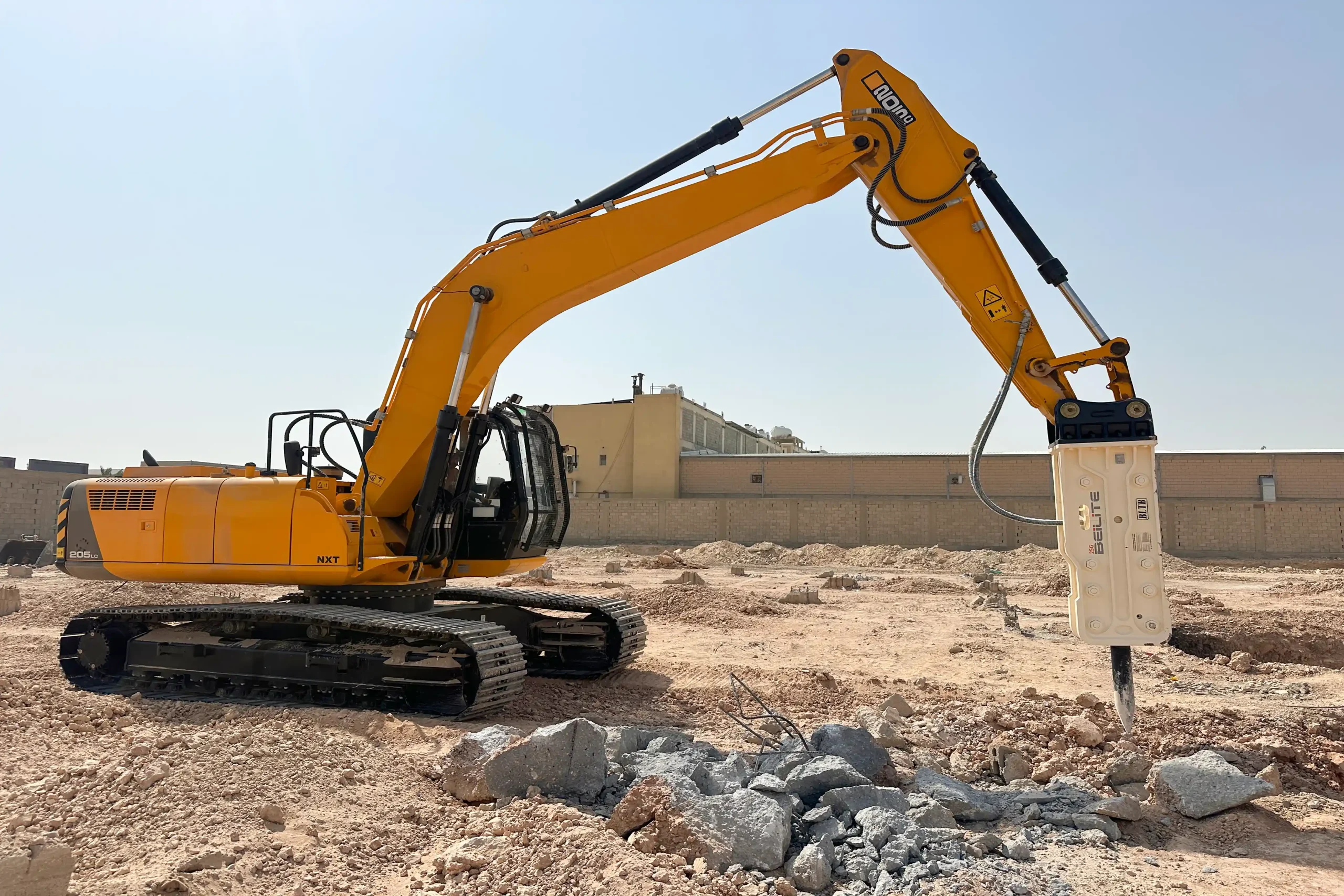
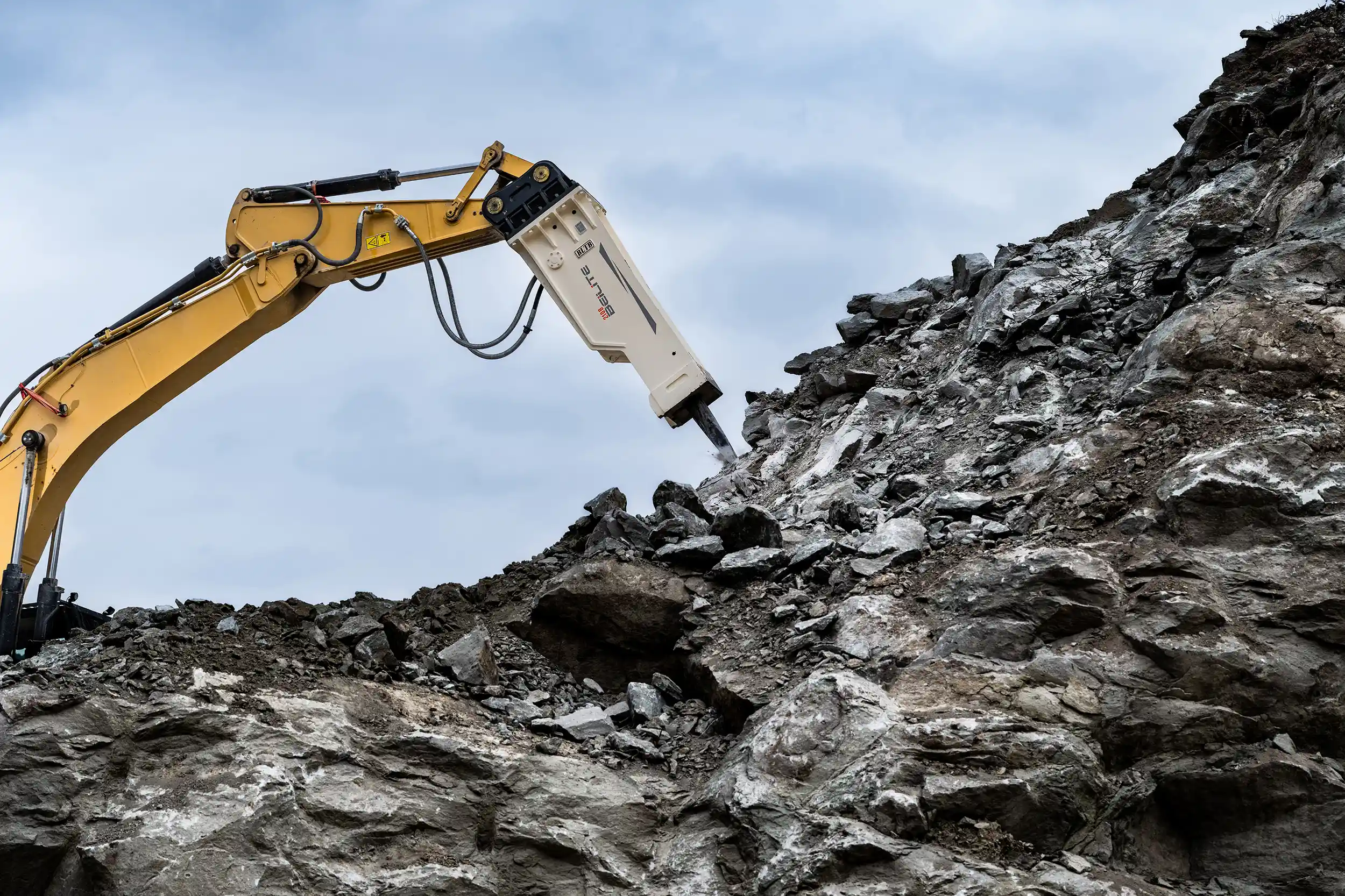
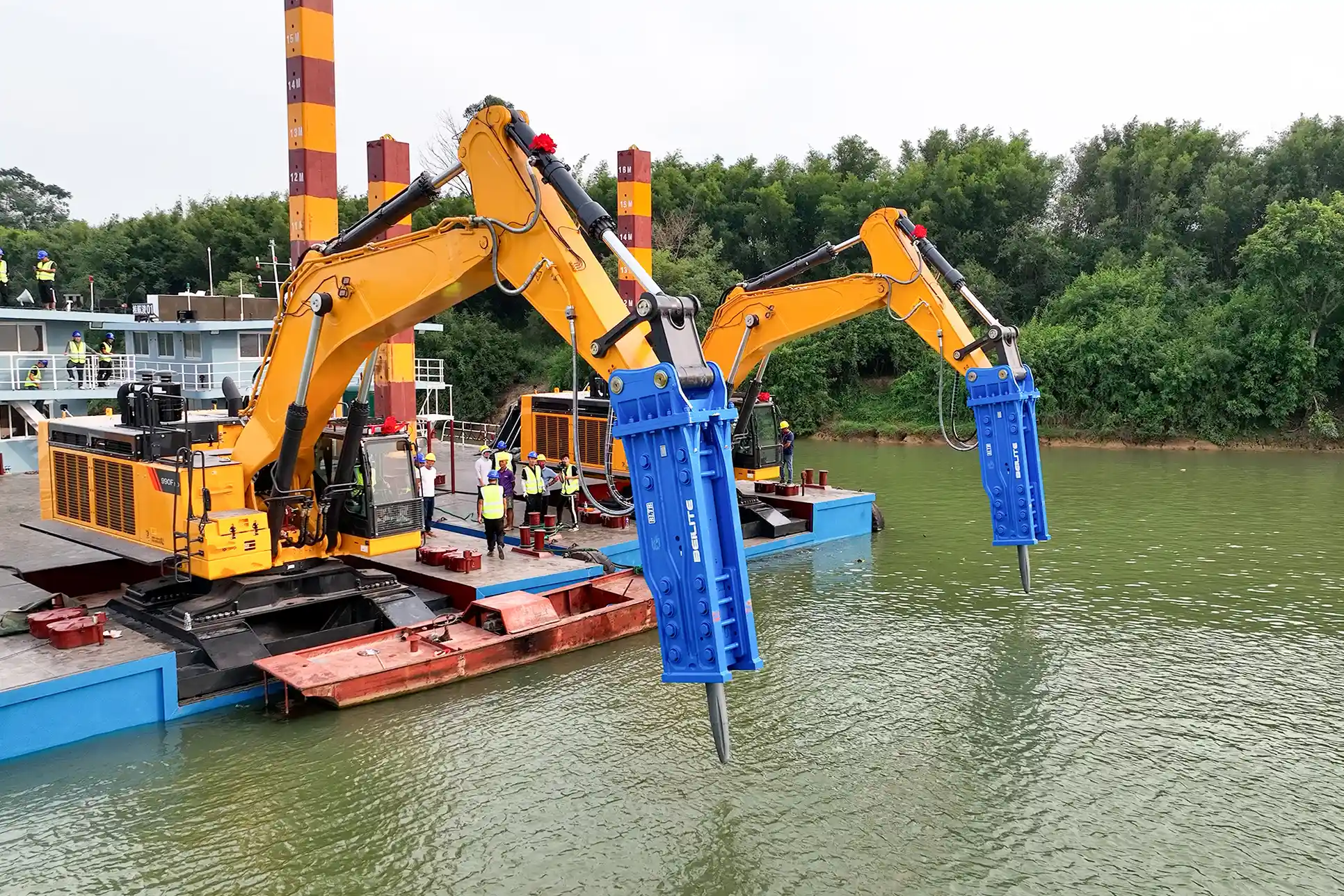
Working conditions shape equipment requirements in ways that product specifications alone cannot capture. Quarrying operations demand robust construction capable of sustained high-impact cycling. Mining environments may require additional protection against abrasive dust and debris. Infrastructure projects in urban areas often benefit from silent breakers that reduce noise complaints, while marine applications need underwater breakers engineered for submersion.
Heavy-duty applications require breakers built to handle higher impact forces without accelerated wear. Understanding whether you’re breaking hard rock or reinforced concrete—and in what quantities—guides selection toward appropriate breaker classes.
| Modèle de disjoncteur | Excavateur applicable (t) | Diamètre du ciseau (mm) | Débit d'huile de travail (L/min) | Applications typiques |
|---|---|---|---|---|
| BLT-45 | 0.8-1.5 | 45 | 20-40 | Precision tasks, mini excavator work |
| BLT-75 | 6-8.5 | 75 | 50-90 | Medium demolition, utility work |
| BLT-125 | 14-18 | 125 | 90-120 | General construction, moderate quarrying |
| BLT-155 | 27-33 | 155 | 180-240 | Heavy quarrying, demanding applications |
| BLT-165 | 33-38 | 165 | 200-260 | Large-scale mining, major demolition |
Why Aftermarket Support Determines Long-Term Value
The relationship with a hydraulic breaker supplier extends well beyond the initial purchase. Aftermarket services and after-sales support capabilities often matter more than purchase price when calculating true ownership costs.
A reliable hydraulic breaker supplier maintains comprehensive support infrastructure. This means readily available spare parts, established maintenance programs, and warranty coverage that actually protects against manufacturing defects. Technical support accessibility and operator training programs contribute to product longevity and help operations maximize their equipment investment.
Global service networks with local dealers provide the timely assistance that keeps projects moving. When a breaker goes down, response time determines whether you lose hours or days.
What Warranty Coverage and Parts Availability Actually Mean
Comprehensive warranty policies signal manufacturer confidence in component longevity. More practically, they provide financial protection against premature failures that would otherwise hit operating budgets.
Parts availability often matters more than warranty terms. Genuine parts ensure quick repair services and maintain original performance specifications. Efficient parts inventory management and robust supply chain systems minimize downtime when components need replacement. Over an equipment lifespan, these factors drive significant cost savings that easily outweigh modest differences in initial purchase price.
Technical Support and Service Network Reach
Expert consultation and technical assistance help operations optimize breaker usage and resolve problems before they escalate. Clear installation guides and comprehensive training programs improve operator safety while enhancing productivity.
A well-established global service network, supported by local dealers and field service teams, ensures prompt assistance regardless of project location. This international reach proves essential for operations working across multiple regions or in remote areas where specialized expertise may be scarce.
L'évolution de la technologie des brise-roches hydrauliques
Hydraulic breaker development continues advancing on multiple fronts, driven by performance demands and growing sustainability requirements.
Advanced materials are extending durability while reducing environmental impact. Smart technology integration enables more precise control and supports predictive maintenance approaches that catch problems before they cause failures. Efficiency improvements target maximum impact energy delivery with minimum fuel consumption.
Noise reduction and vibration damping have moved from premium features to standard expectations, addressing both environmental regulations and operator comfort concerns. The industry trajectory points toward eco-friendly breakers that maintain powerful performance while reducing ecological footprints—a balance that seemed impossible a decade ago but now drives serious engineering investment.
Working with BEILITE Machinery for Hydraulic Breaker Solutions
BEILITE Machinery Co., LTD has operated as a national high-tech enterprise since 2002, focusing on high-end hydraulic breaker R&D and manufacturing. The company holds hundreds of patents, participates in national standards development, and exports BLT and BLTB brand equipment to over 100 countries.
For operations seeking advanced hydraulic breaker solutions backed by proven engineering capability, BEILITE offers expert consultation and comprehensive product support. Contact [email protected] or call 40008-40008 to discuss specific project requirements.
Frequently Asked Questions About Hydraulic Breakers and Suppliers
What actually makes a hydraulic breaker worth paying more for?
Higher-end hydraulic breakers from established manufacturers incorporate advanced R&D, superior materials, and precise engineering backed by rigorous quality control. The practical differences show up in impact energy consistency, durability under heavy use, and reduced maintenance requirements. Over a typical service life, these factors often deliver lower total ownership costs despite higher purchase prices. The key is matching equipment quality to actual application demands—not every operation needs top-tier specifications.
How can buyers verify a hydraulic breaker manufacturer’s reliability before purchasing?
Look for international certifications like CE and ISO as baseline indicators, then dig deeper into export history and service network coverage. Manufacturers participating in national or international standard-setting typically demonstrate stronger technical foundations. Request references from operations running similar applications, and evaluate spare parts availability and technical support responsiveness. A manufacturer’s willingness to provide detailed performance data and application guidance often reveals more than marketing materials.
Which technical specifications matter most when comparing hydraulic breaker models?
Impact energy measured in joules indicates breaking power, while operating pressure and flow rate requirements determine excavator compatibility. Chisel diameter and type affect application suitability for specific materials. Beyond these basics, evaluate noise and vibration specifications, material hardness ratings for components subject to wear, and documented service life expectations. Correct equipment matching requires balancing all these factors against actual project requirements rather than selecting based on any single specification.