Anglais
 Français
Comment lire un manomètre à azote : Précision essentielle pour l'hydraulique
Getting a nitrogen pressure reading right matters more than most operators realize. I’ve seen hydraulic systems fail not because of major component breakdowns, but because someone misread a gauge or ignored a slow drift in accumulator pressure. The gauge itself is a simple instrument, but the consequences of getting it wrong ripple through entire operations—downtime, seal damage, reduced impact force on breakers. This piece walks through how to read these gauges properly, what affects their accuracy, and why the numbers matter so much for hydraulic equipment like brise-roche hydrauliques.
How Nitrogen Pressure Gauges Work
Nitrogen pressure gauges give you a direct window into what’s happening inside a pressurized system. They translate internal gas pressure into a visual reading that operators can act on. The mechanics behind this are straightforward, but understanding them helps explain why certain gauges perform better in specific conditions.
Two main types dominate industrial use. Analog gauges rely on mechanical elements—typically a bourdon tube or diaphragm—that physically deform under pressure. This deformation moves a needle across a calibrated dial. Digital pressure gauges take a different approach, using electronic pressure sensors that convert pressure into electrical signals displayed as numbers. Both measure in standard pressure units: PSI, Bar, or kPa.
The choice between analog and digital comes down to application requirements. Analog gauges need no external power and handle rough environments well. Digital versions offer tighter accuracy and features like data logging or peak hold functions. A pressure regulator often includes an integrated gauge to show output pressure, making the two technologies common across different parts of the same system.
| Fonctionnalité | Analog Gauge | Digital Gauge |
|---|---|---|
| Mechanism | Bourdon tube, diaphragm, or bellows | Electronic pressure sensor |
| Display | Needle on a calibrated dial | Numerical display (LCD/LED) |
| Accuracy | Typically 0.5% to 3% of full scale | Often higher, 0.25% to 0.05% of full scale |
| Readability | Quick visual check, trend indication | Precise numerical value |
| Source d'énergie | Mechanical, no external power required | Battery or external power |
| Coût | Generally lower | Generally higher |
| Caractéristiques | Simple, robust | Data logging, backlighting, peak hold |
What Makes Up a Nitrogen Pressure Gauge
Several components work together inside these instruments. The gauge dial displays the pressure scale and units, while the needle tracks current pressure. The pressure sensor—whether bourdon tube or diaphragm—responds to pressure changes by deforming, and this movement translates into needle position. A connection thread secures the gauge to the system and must create a leak-free seal. The case protects internal mechanisms from physical damage and environmental exposure. Some gauges incorporate a safety valve to prevent damage from over-pressurization. The pressure range stamped on the dial indicates the minimum and maximum values the gauge can accurately measure.
Recommended Reading: Optimisation de la température de l'huile hydraulique pour une performance maximale du système
Taking an Accurate Nitrogen Pressure Reading
Reading a nitrogen pressure gauge correctly requires attention to several details that are easy to overlook. Rushing through this process or skipping steps leads to reading errors that can cascade into maintenance problems or equipment damage. For hydraulic systems and hydraulic accumulators, accurate pre-charge pressure readings directly affect performance.
Start by confirming the system is stable. A nitrogen cylinder or pressurized system that’s actively changing pressure will give you a moving target. Wait for conditions to settle before taking your measurement.
Clean the gauge face. Dirt or moisture on the dial makes it harder to read fine graduations accurately. A quick wipe takes seconds and eliminates one source of error.
Position yourself directly in front of the gauge at eye level. Viewing the needle from an angle creates parallax error—the needle appears to point at a different value than it actually indicates. This error can be significant on gauges with fine graduations.
Check the pressure units on the dial. PSI, Bar, and kPa are all common, and mixing them up leads to serious miscalculations. Confirm the units match what your equipment specifications require.
Read the major markings first to establish the general range, then use the minor markings to refine your reading. If the needle falls between two lines, estimate the position as precisely as the scale allows.
Before connecting the gauge, verify it reads zero when depressurized. A needle that doesn’t return to zero indicates the gauge needs calibration or replacement. This zero adjustment check catches problems before they affect your measurements.
Record the reading with its units. Documentation supports maintenance tracking and helps identify trends over time.
Compare your reading against the manufacturer’s recommended optimal pressure for your specific equipment. A number on its own means little without context.
Recommended Reading: Hydraulic Breaker for Mini Excavator: Selection and Performance
What Affects Gauge Accuracy
Several factors influence whether a nitrogen pressure gauge gives you reliable data. Understanding these helps prevent reading errors and extends gauge lifespan.
Calibration drift happens over time, even with quality instruments. Internal components fatigue, and the relationship between pressure and needle position shifts. Regular gauge calibration by certified professionals corrects this drift before it becomes significant.
Temperature affects accuracy more than many operators expect. Metal components expand and contract with temperature changes, altering the mechanical response to pressure. Some gauges include temperature compensation, but even these have limits. Taking readings in extreme heat or cold requires awareness of this effect.
Vibration and mechanical shock degrade accuracy over time. A gauge mounted on equipment that vibrates heavily will lose calibration faster than one in a stable location. Proper mounting and vibration isolation help, but some environments simply demand more frequent calibration.
Pressure fluctuations during measurement create unstable readings. A system that’s actively cycling or experiencing transient pressure spikes won’t give you a meaningful steady-state value. Wait for stable pressure conditions before recording data.
Recommended Reading: Comment graisser un brise-roche hydraulique pour une performance optimale
Calibration Frequency Guidelines
How often a nitrogen pressure gauge needs calibration depends on how it’s used. Annual calibration works for most industrial applications under normal conditions. Gauges in critical applications—where an incorrect reading could cause safety issues or major equipment damage—often need calibration every six months.
Harsh environments accelerate calibration drift. Exposure to corrosive atmospheres, extreme temperatures, or heavy vibration all shorten the interval between calibrations. Manufacturer guidelines provide a starting point, but actual conditions should drive the schedule.
Certified calibration ensures the gauge meets its specified accuracy across the full pressure range. This matters more than many realize—a gauge that’s accurate at mid-range but drifts at the extremes can still cause problems even if it passes a single-point check.
Recommended Reading: Brise-roche hydraulique pour l'exploitation minière : Optimisation de l'efficacité du cassage de roches
Safety When Working with High-Pressure Nitrogen
Nitrogen itself is inert and non-flammable, which sometimes leads to complacency. The real hazards come from pressure and displacement. High-pressure equipment can fail catastrophically if components are damaged or over-pressurized. Nitrogen can also displace oxygen in enclosed spaces, creating an asphyxiation risk that develops without warning since the gas is odorless and colorless.
Proper ventilation is non-negotiable when working with nitrogen systems indoors or in confined spaces. Oxygen monitors provide an additional layer of protection in areas where displacement is possible.
Personal protective equipment—safety glasses and gloves at minimum—should be worn when connecting or disconnecting gauges and cylinders. A fitting failure under pressure can cause serious injury.
Inspect all connections, hoses, and the gauge itself before pressurizing. Look for cracks, corrosion, damaged threads, or signs of previous leaks. A soap solution applied to connections reveals small gas leaks that might otherwise go unnoticed.
Safety valves and pressure relief devices must be present and functional. These components prevent over-pressurization from damaging equipment or causing failures. Never disable or bypass them, and verify they’re rated for the system’s maximum expected pressure.
Recommended Reading: Mastering Hydraulic Schematics: A Technical Interpretation Guide
Nitrogen Pressure and Hydraulic Breaker Performance
The connection between nitrogen pressure and hydraulic breaker performance is direct and measurable. These tools—workhorses in construction, mining, and demolition—depend on precise accumulator charging to deliver consistent impact force. Getting the pre-charge pressure wrong affects everything from cycle time to component wear.
The nitrogen accumulator in a hydraulic breaker stores energy between piston cycles. When the hydraulic system releases this stored energy, it adds to the impact force delivered to the tool. The pre-charge pressure determines how much energy the accumulator can store and how efficiently it releases that energy.
Low pre-charge pressure reduces the energy available for each impact. The breaker still operates, but with diminished force and longer cycle times. Operators sometimes compensate by increasing hydraulic flow, which stresses other components and reduces efficiency.
Excessive pre-charge pressure creates different problems. The accumulator can’t absorb hydraulic pulses effectively, leading to cavitation and pressure spikes that damage seals. Seal life drops significantly when operating outside the specified pressure range.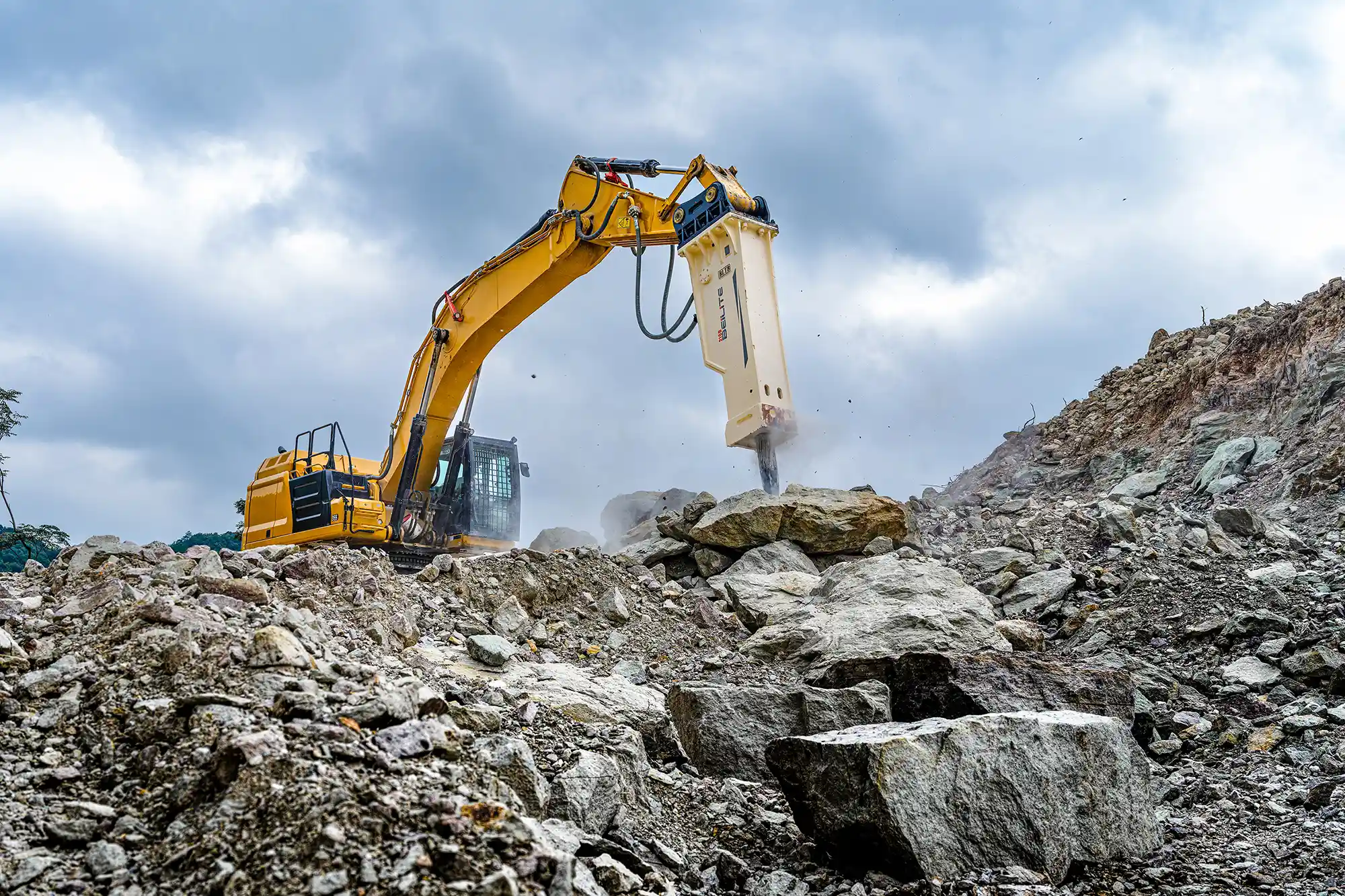
Why Pressure Specifications Vary by Model
Different hydraulic breaker models have different nitrogen pressure requirements because their internal geometry, piston mass, and intended applications vary. A compact breaker designed for mini excavators operates at different pressures than a heavy-duty unit built for 35-ton machines.
Beilite Machinery’s BLT hydraulic breakers illustrate this variation. Each model has specific rear cylinder and accumulator nitrogen pressure specifications calibrated to its design parameters.
Recommended Reading:
Replace a Hydraulic Breaker Diaphragm: Expert Steps
Piston de brise-roche hydraulique : Ingénierie, performance et longévité
| Modèle | Rear Cylinder Nitrogen Pressure (bar) | Accumulator Nitrogen Pressure (bar) | Excavateur applicable (t) |
|---|---|---|---|
| BLT-40 | 14–17 | N/A | 0.5-1.2 |
| BLT-70 | 14–17 | 55–60 | 4.5-6 |
| BLT-100 | 14–17 | 55–60 | 10-14 |
| BLT-135 | 6–8 | 55–60 | 18-22 |
| BLT-165 | 18-22 | 55–60 | 33-38 |
The BLT-135 stands out with its lower rear cylinder pressure requirement compared to smaller models. This reflects its internal design rather than indicating less demanding operation. Following these specifications during hydraulic system maintenance directly affects equipment longevity and consistent performance.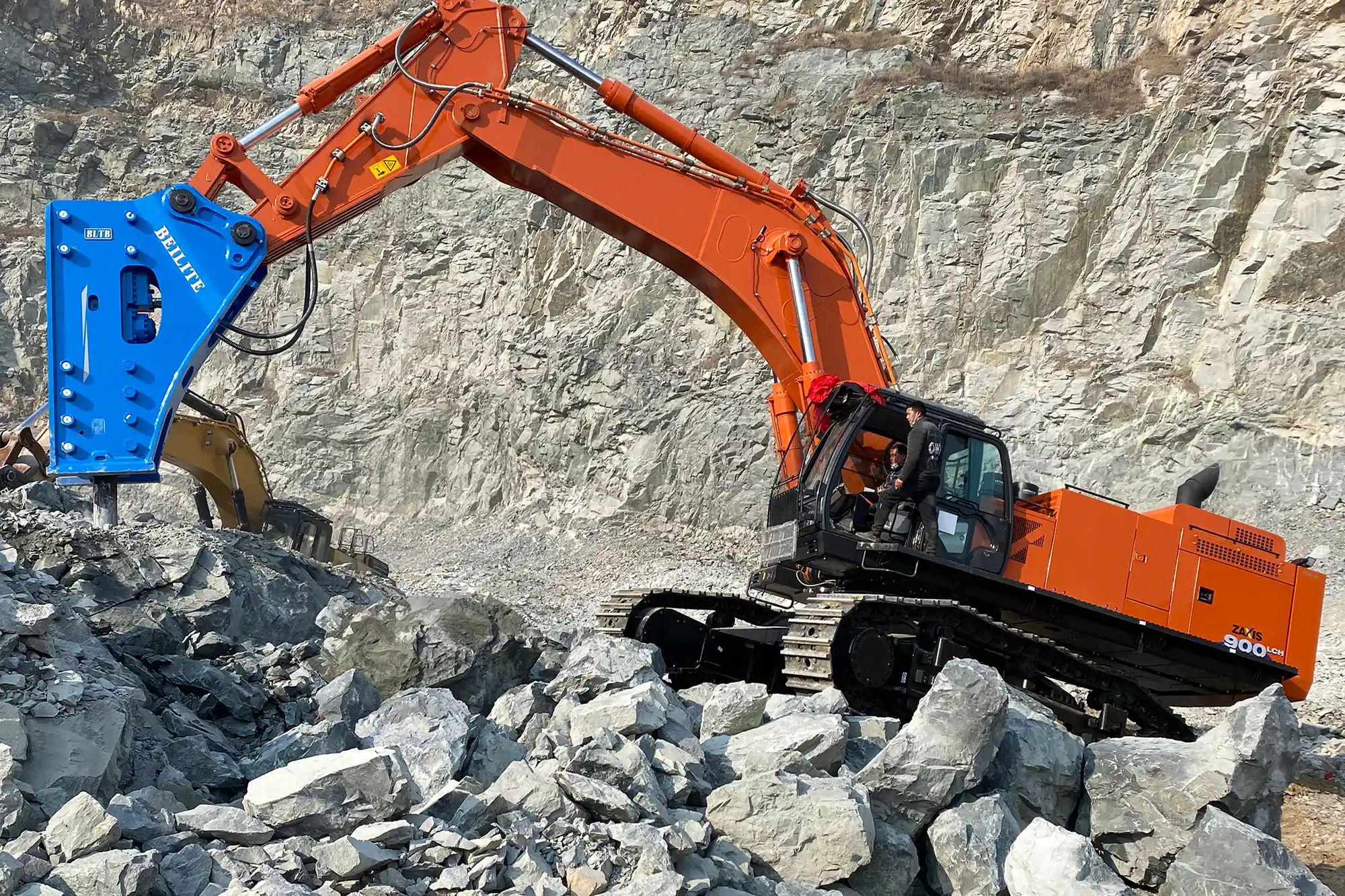
Partner with Beilite for Hydraulic Equipment Excellence
Precise nitrogen pressure management protects your investment in hydraulic equipment and keeps operations running efficiently. Beilite Machinery Co., LTD brings decades of hydraulic breaker R&D and manufacturing experience to every product we build. Our BLT and BLTB hydraulic breakers serve customers in over 100 countries who depend on reliable performance in demanding conditions. Reach out at [email protected] or 40008-40008 to discuss your application requirements or learn more about our product range.
Frequently Asked Questions About Nitrogen Pressure Gauges
What is the correct pressure for a hydraulic breaker’s nitrogen accumulator?
The correct nitrogen pressure varies by breaker model and manufacturer. There’s no universal number that applies across different equipment. Your specific breaker’s operation manual contains the recommended pre-charge pressure for both the rear cylinder and accumulator. Using pressures outside these specifications reduces impact force, accelerates wear, and can damage hydraulic system components. When in doubt, contact the manufacturer rather than guessing.
Can I use any pressure gauge for nitrogen gas?
Using the wrong gauge creates accuracy problems and potential safety hazards. Gauges designed for other gases or liquids may have incompatible materials that degrade when exposed to nitrogen, or pressure ranges that don’t match your application. The gauge’s rated pressure range should meet or exceed the maximum nitrogen pressure you’ll encounter. Material compatibility matters because some elastomers and metals react differently to various gases. Stick with gauges specifically rated for nitrogen service.
What are the signs of a faulty nitrogen pressure gauge?
A gauge that doesn’t return to zero when disconnected from a pressurized system needs attention. Other warning signs include erratic needle movement, readings that don’t match known system conditions, physical damage to the case or connection fitting, and a cracked or fogged display lens. A gauge that consistently reads differently from a known-good reference gauge has drifted out of calibration. Replace or recalibrate suspect gauges rather than relying on questionable readings for maintenance decisions.