 English
 French
Hydraulic Breaker Explained: Core Concepts and Operational Principles
Choosing a breaker starts with getting a firm grip on capacity and impact rating. When those match the job, performance stays steady and you avoid structural stress or surprise failures. Check the carrier’s specifications, the material you need to break, the operating environment, and the output you expect. Aligning impact energy with actual working conditions boosts efficiency, cuts wear, and extends equipment life. With that baseline in place, I’ll walk through the key factors that shape a smart choice for your machine and site.
What is a Hydraulic Breaker: Fundamental Definition
A hydraulic breaker, often called a hydraulic hammer or rock breaker, is a high-powered percussion tool mounted to an excavator or other heavy equipment. It draws power from the excavator’s auxiliary hydraulic system to drive a robust percussive mechanism. The primary task is to break hard materials such as rock, concrete, and asphalt with speed and consistency. Compared with traditional demolition methods, hydraulic breakers deliver high-impact energy, making them indispensable in construction, mining, and quarrying.
At its core, a hydraulic breaker converts hydraulic pressure into kinetic energy that drives a chisel or moil point. Repeated high-force strikes fracture and disintegrate tough materials. The design emphasizes efficient energy transfer to minimize losses and maximize breaking output. We utilize advanced engineering to ensure our hydraulic breakers, like the BLT and BLTB series, deliver consistent, reliable performance across varied applications. These attachments expand what excavators can do, turning them into capable demolition and excavation tools. Understanding the basic hydraulic hammer definition helps clarify its place in modern heavy industry.
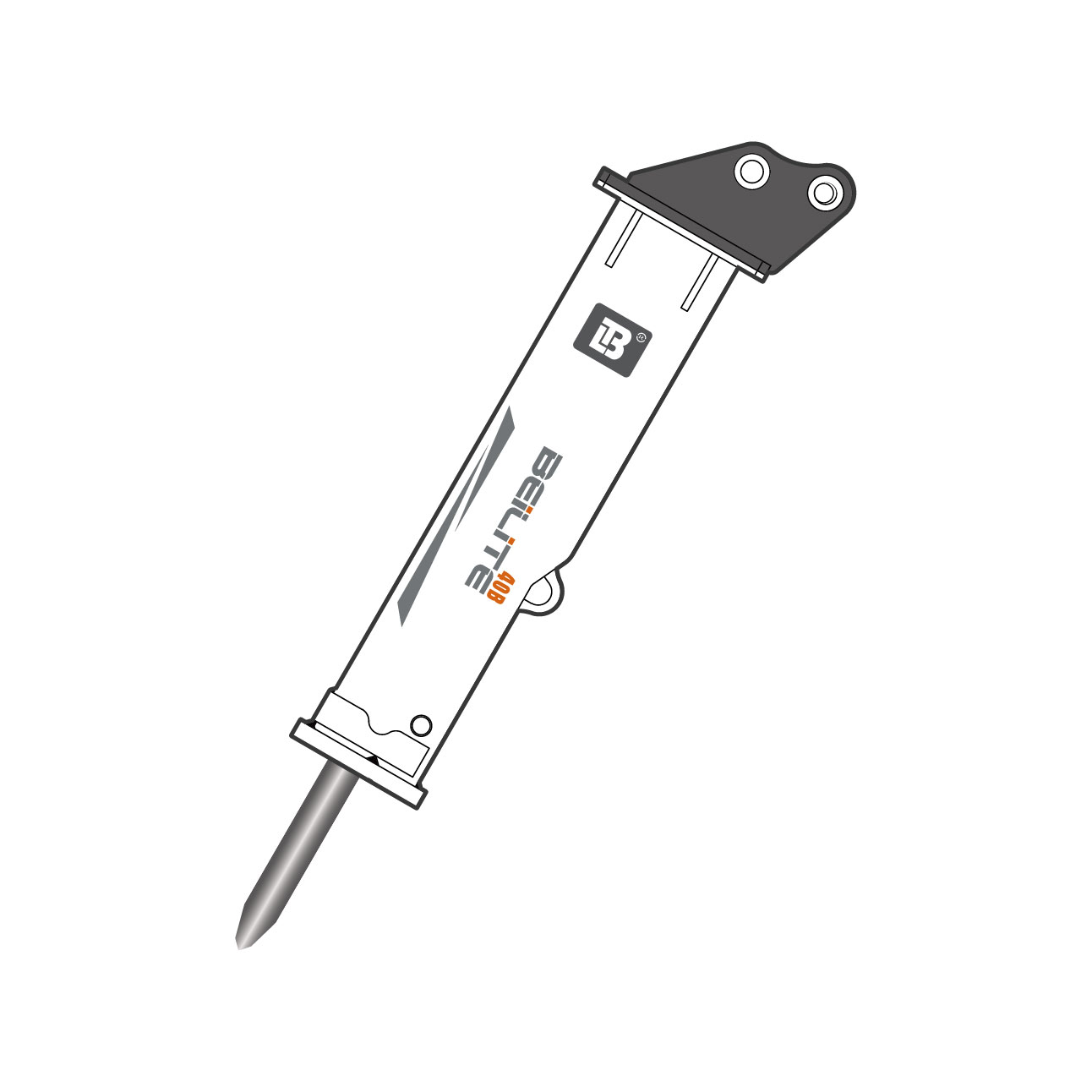
Engineering Principles of Hydraulic Breaker Operation
A hydraulic breaker operates through precise hydraulic power transfer and a tightly engineered percussion system. Hydraulic oil from the carrier’s pump flows into the breaker and actuates a piston. The piston accelerates rapidly downward, striking a tool bit (chisel or moil point) at high velocity. That impact energy transfers directly into the target material.
Key components include the main valve, piston, cylinder, and a nitrogen accumulator. The main valve routes hydraulic fluid to control piston motion. As the piston moves upward, hydraulic pressure rises and the nitrogen accumulator stores energy. That stored energy then helps drive the piston downward, amplifying impact force. The nitrogen accumulator function is critical for steady striking power and for absorbing recoil to protect both breaker and excavator. This cyclical piston action, powered by hydraulic pressure with nitrogen assistance, produces the continuous, forceful blows that define a hydraulic breaker. Our designs focus on refining this mechanism for maximum efficiency and durability.
Diverse Applications of Hydraulic Breakers
Hydraulic breakers excel across many industries thanks to their power and adaptability. In construction demolition, they handle concrete structures, foundations, and reinforced concrete with confidence. For road construction equipment, they are central to breaking asphalt and concrete pavements during repair or expansion.
The mining rock breaking sector depends on hydraulic breakers for primary and secondary rock breaking, tunnel excavation, and scaling. In quarrying operations, they fragment large rocks into manageable sizes for crushing and processing. Their robust build allows reliable work in tough conditions, from urban redevelopment to remote quarries. They are also vital for trenching, enabling rapid excavation through hard ground or rock layers for utility installations. The BLT-series, for example, offers models for excavators ranging from 0.5 to 38 tons, showing how broad the fit can be.
| Model | Applicable Excavator (t) | Chisel Diameter (mm) | Working Pressure (bar) | Impact Frequency (bpm) |
|---|---|---|---|---|
| BLT-40 | 0.5–1.2 | 40 | 90–120 | 800–1400 |
| BLT-75 | 6–8.5 | 75 | 120–150 | 400–800 |
| BLT-125 | 14–18 | 125 | 150–170 | 350–650 |
| BLT-155 | 27–33 | 155 | 200–220 | 200–300 |
| BLT-165 | 33–38 | 165 | 210–230 | 150–300 |
For more specialized tasks, Hydraulic Breaker Hammer for Underwater Construction models are available, built to withstand harsh subaquatic environments. These specialized tools highlight the wide capabilities of hydraulic breaking technology.
If you are interested in exploring specific solutions for urban infrastructure, consider reviewing our article on 《Hydraulic Breaker for Municipal Engineering,Urban Road & Utility Works》.
Innovations and Future of Hydraulic Breaker Technology
Hydraulic breaker technology continues to advance with a push for higher efficiency, lower environmental impact, and better operator safety. Current developments include smart hydraulic breakers with sensors and telemetry for real-time performance monitoring, enabling predictive maintenance and fine-tuned settings.
Energy efficient breakers are also gaining ground, using advanced hydraulic circuits and energy recovery systems to cut fuel use while maximizing output. Noise reduction remains a priority for urban demolition, where tighter noise regulations are common. We are actively researching and implementing features such as enclosed housings and advanced dampening systems to reduce operational noise. The path ahead points to more automation, integrating hydraulic breakers with robotic systems for greater precision and safety in hazardous environments. These sustainable breaking solutions reflect our commitment to the next generation of demolition tools.
Frequently Asked Questions
What is the primary function of a hydraulic breaker?
The primary function of a hydraulic breaker is to efficiently break hard materials such as rock, concrete, and asphalt. It converts hydraulic pressure from a carrier machine into powerful percussive blows, making it an essential tool for demolition and excavation tasks. This capability makes it a versatile hydraulic breaker Hammer.
How does a hydraulic breaker differ from other demolition tools?
A hydraulic breaker differs from other demolition tools, such as jackhammers, mainly by power source and scale. Hydraulic breakers are larger, excavator-mounted attachments powered by the machine’s hydraulic system, delivering much higher impact energy for heavy-duty work. Jackhammers are usually handheld and pneumatically or electrically powered, better suited to lighter demolition.
What factors influence the performance of a hydraulic breaker?
Several factors shape a hydraulic breaker’s performance, including the carrier machine’s hydraulic flow and pressure, the breaker’s design (for example, piston size and accumulator pressure), and the material being broken. Properly matching the breaker to the excavator and keeping up with maintenance, including correct nitrogen accumulator pressure, are key to strong efficiency and long service life.
Discover Advanced Hydraulic Breaking Solutions
For those seeking high-performance demolition tools and expert hydraulic solutions, Beilite Machinery Co., LTD. offers a wide range of BLT and BLTB products. As a national high-tech enterprise established in 2002, we have pioneered core technologies and hold hundreds of patents in hydraulic breaker manufacturing. Our commitment to excellence ensures reliable and efficient equipment for any project. Contact us today to discuss your specific requirements or to learn more about our innovative solutions. Reach out via email at [email protected] or call us at 40008-40008.