 Anglais
 Français
Hydraulic Breaker for Concrete Recycling: Boost ROI and Sustainability
Concrete recycling has become one of those operational shifts that actually pays for itself — not just in reduced disposal fees, but in the way it changes how a demolition site flows. The hydraulic breaker sits at the center of that process, doing the unglamorous work of turning slabs and foundations into material that can be crushed, screened, and reused. Getting the equipment selection and operation right determines whether recycling adds value or just adds steps.
Why Hydraulic Breakers Matter for Concrete Recycling Economics
Construction and demolition waste creates real logistical and financial pressure. Concrete makes up a significant portion of that waste stream, and hauling it to landfills costs money while consuming limited disposal capacity. The alternative — processing it on-site or at a nearby facility into recycled aggregate — requires breaking the material down first.
Hydraulic breakers handle that initial fragmentation. They reduce large concrete sections into pieces small enough for crushers to process efficiently. The quality of this first step affects everything downstream: how fast the crusher runs, how consistent the aggregate gradation turns out, how much rebar needs manual separation.
When done well, concrete recycling can divert over 70% of demolition material from landfills. That translates to lower tipping fees, reduced trucking, and less demand for virgin aggregate. Urban renewal projects and infrastructure work benefit particularly, since they generate high volumes of concrete waste and often have space constraints that make on-site processing attractive.
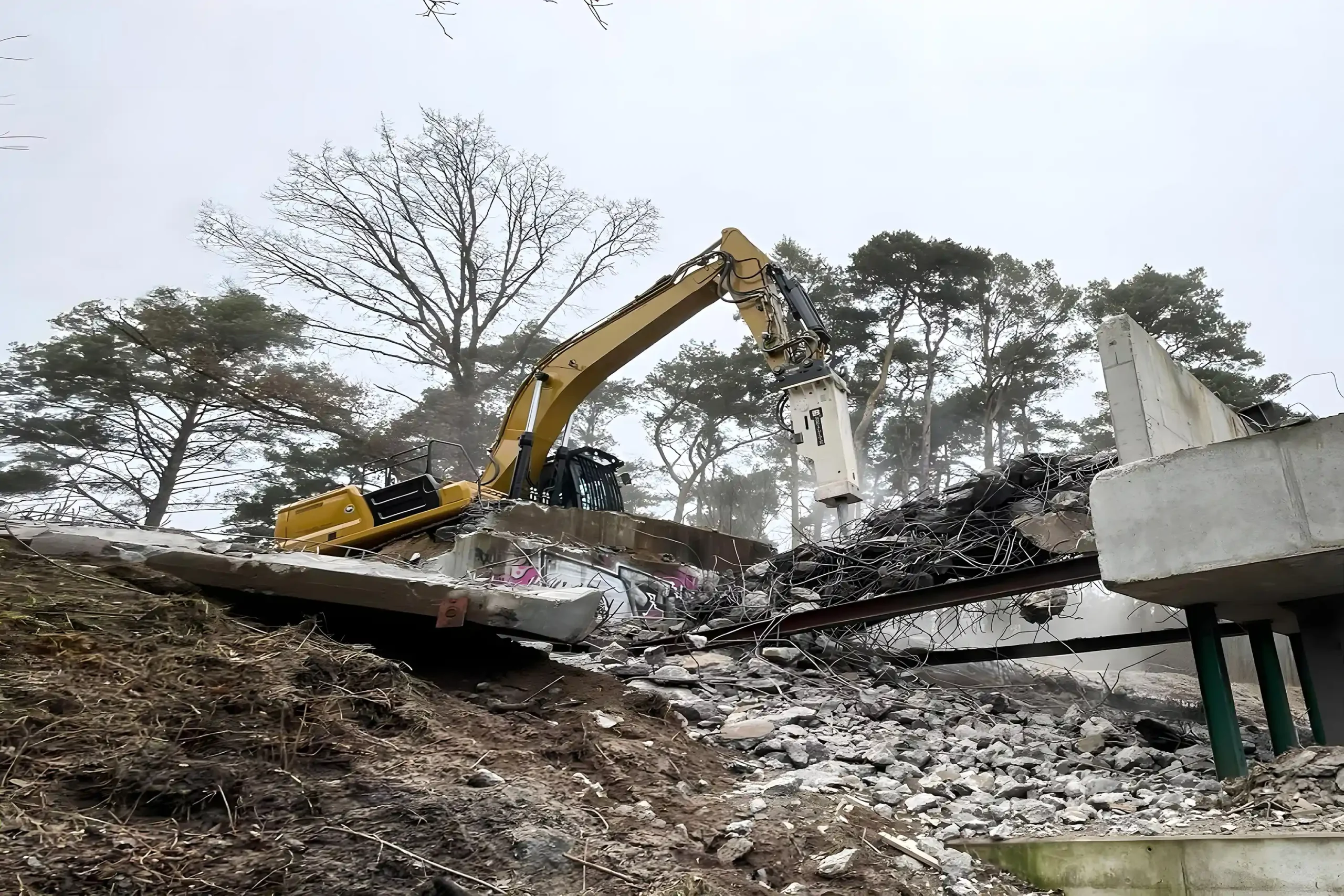
Matching Hydraulic Breaker Specifications to Concrete Conditions
The selection process involves more than just picking a breaker that fits the excavator. Concrete varies — lightly reinforced residential foundations behave differently than heavily reinforced commercial structures or mass concrete bridge piers. Each demands a different balance of impact energy, blow frequency, and chisel geometry.
Reinforced concrete with dense rebar requires higher impact energy and chisels designed to shear steel without deflecting. Mass concrete benefits from sustained, powerful strikes that propagate fractures through the material. Lighter work, like breaking up residential slabs, can use smaller breakers that cycle faster and cause less carrier fatigue.
Hydraulic system compatibility matters as much as raw power. The breaker needs to match the excavator’s flow and pressure capabilities. Undersized hydraulic supply starves the breaker; oversized supply wastes fuel and generates excess heat. BEILITE designs its hydraulic breakers for integration across a range of carrier sizes, which simplifies the matching process.
| Modèle de disjoncteur | Excavator Weight (t) | Diamètre du ciseau (mm) | Impact Energy (Approx.) | Ideal Application |
|---|---|---|---|---|
| BLT-60 | 3-5.5 | 60 | Medium | Light Concrete, Foundations |
| BLT-100 | 10-14 | 100 | Haut | Reinforced Concrete, Medium Structures |
| BLT-150 | 24-27 | 150 | Very High | Mass Concrete, Heavy Foundations |
Concrete Types Suitable for Hydraulic Breaker Processing
Hydraulic breakers handle a broad range of concrete compositions. Reinforced concrete, pre-stressed concrete, mass concrete, and standard foundations all respond to hydraulic breaking, though each requires adjusted technique and sometimes different chisel selection. Materials from building demolition, bridge removal, and civil engineering projects all fall within the capability range. The presence of rebar doesn’t prevent recycling — it just adds a separation step after initial breaking.
Operational Practices That Affect Output and Cost
Site setup influences productivity more than operators sometimes realize. Clear access routes let the excavator reposition efficiently. Designated staging areas for broken material prevent double-handling. When material flows smoothly from breaking to crushing to stockpiling, the entire operation runs faster.
Operator technique matters too. Experienced operators develop a feel for how concrete fractures, adjusting strike patterns to exploit natural weaknesses in the material. They avoid blank firing — striking without material contact — which accelerates wear on internal components. They maintain proper tool angle, which improves energy transfer and reduces side loads on the chisel.
Dust suppression and noise management aren’t just regulatory requirements. Dust obscures visibility and creates respiratory hazards. Excessive noise fatigues operators and draws complaints from neighboring properties. Water sprays and equipment enclosures address both issues while keeping the site functional.
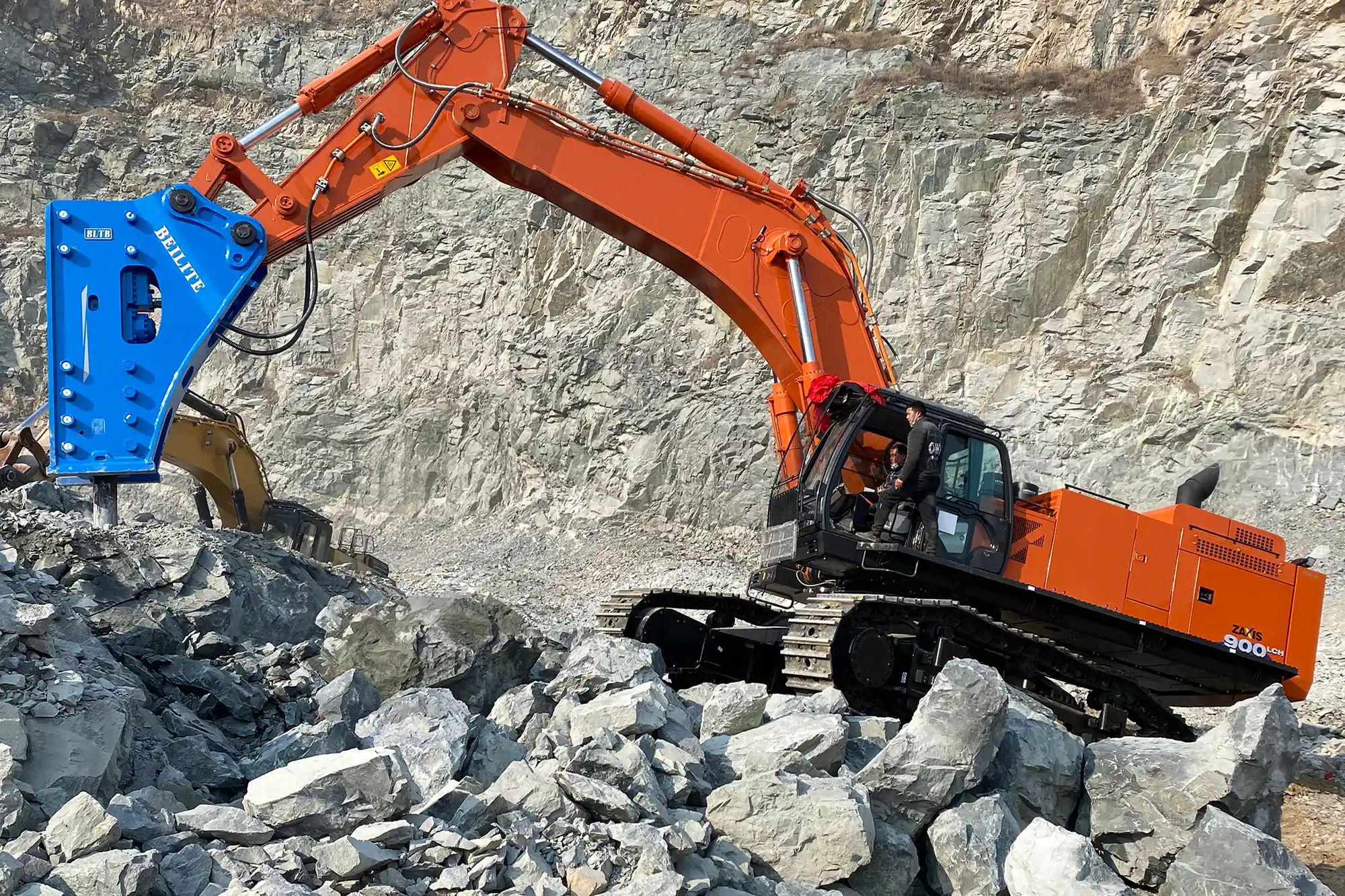
Maintenance Practices That Protect Equipment Investment
Hydraulic breakers operate under severe conditions — high impact loads, abrasive material contact, exposure to dust and debris. Without consistent maintenance, performance degrades and unexpected failures interrupt work.
Daily checks catch problems early. Operators should inspect chisel condition, check for hydraulic leaks, and verify that mounting hardware remains tight. Grease points need regular attention; inadequate lubrication accelerates bushing wear and allows play to develop in the tool retention system.
Periodic servicing goes deeper. Seals wear and need replacement before they fail completely. Accumulators lose charge over time and require recharging or diaphragm replacement. Hydraulic oil condition affects internal component life — contaminated or degraded oil causes accelerated wear throughout the system.
The economics favor preventive maintenance. Scheduled service costs less than emergency repairs, and planned downtime disrupts projects less than unexpected breakdowns. Equipment that receives consistent care maintains its performance characteristics longer, protecting the original investment.
Why Maintenance Directly Affects Recycling Profitability
Concrete recycling operations depend on consistent throughput. When a hydraulic breaker goes down, the entire material flow stops. Crushers sit idle, trucks wait, and labor costs accumulate without productive output. Regular maintenance prevents these interruptions.
Beyond uptime, well-maintained breakers perform better. They deliver full impact energy with each blow, breaking material faster. They cycle at designed frequency, maximizing strikes per hour. This performance consistency translates directly to tons processed per shift — the metric that drives recycling economics.
Safety Requirements for Hydraulic Breaker Operations
The forces involved in concrete breaking create genuine hazards. Flying debris can cause serious injury; the breaker itself generates significant noise and vibration. Operators need hard hats, safety glasses, hearing protection, and steel-toed boots as baseline PPE.
Exclusion zones keep unauthorized personnel away from the work area. The radius depends on the breaker size and material being processed, but erring toward larger zones costs nothing and prevents accidents.
Pre-operation checks verify that both the breaker and carrier are mechanically sound. Loose mounting hardware, damaged hydraulic lines, or malfunctioning safety systems should halt work until repairs are complete. The few minutes spent on inspection prevent incidents that could injure workers or damage equipment.
Economic and Environmental Returns from Recycled Aggregate
Recycled concrete aggregate offers cost advantages when the logistics work out. Local sourcing eliminates long hauls from distant quarries. On-site processing removes trucking costs entirely for some projects. Reduced disposal fees add to the savings.
The environmental case is straightforward. Every ton of recycled aggregate displaces a ton of virgin material that would otherwise require quarrying, crushing, and transport. The carbon footprint difference is measurable, and increasingly, project specifications require or incentivize recycled content.
Green building certification programs recognize recycled aggregate use. Projects pursuing LEED or similar standards can earn points for incorporating recycled materials, which may translate to higher property values or easier permitting. The hydraulic breaker enables this entire value chain by performing the initial size reduction that makes recycling practical.
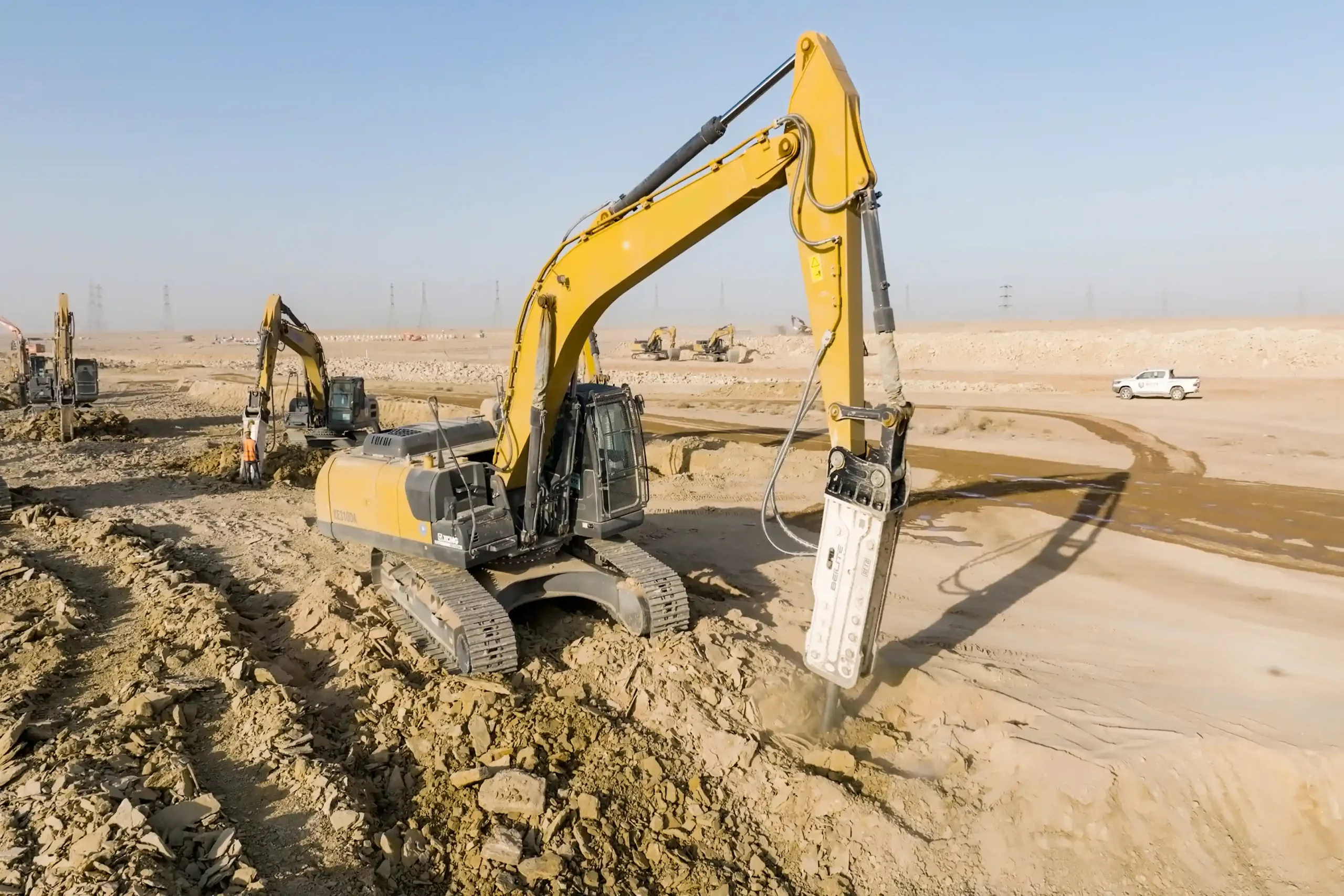
How Hydraulic Breakers Enable Circular Material Flows
The circular economy concept depends on keeping materials in productive use rather than disposing of them. For concrete, this means transforming demolition waste into aggregate suitable for new construction. Hydraulic breakers perform the critical first step — reducing large concrete sections to sizes that crushers can process.
Without effective initial breaking, recycling becomes impractical. Material that’s too large jams crushers or requires excessive energy to process. Material with embedded rebar needs breaking that exposes the steel for separation. The hydraulic breaker’s ability to handle these challenges determines whether recycling succeeds as a practical operation.
Common Questions About Hydraulic Breakers in Concrete Recycling
What distinguishes BEILITE hydraulic breakers for heavy concrete recycling work?
BEILITE hydraulic breakers incorporate design features that address the specific demands of concrete recycling. The internal components are engineered for sustained high-impact operation, and the housing construction resists the abrasive conditions common on demolition sites. Manufacturing follows national standards, which provides baseline assurance of material quality and dimensional accuracy. The result is equipment that maintains performance through extended use on reinforced concrete and other challenging materials.
How do BEILITE hydraulic breakers affect project cost structures?
Efficient breaking reduces the time required to process a given volume of concrete, which lowers labor and equipment costs per ton. Durable construction means fewer repairs and longer intervals between major service. The ability to produce consistent fragment sizes improves downstream crusher efficiency, reducing energy consumption and wear on that equipment. These factors combine to improve the overall cost structure of recycling operations.
Can BEILITE hydraulic breakers work with different excavator brands and sizes?
BEILITE produces BLT and BLTB series hydraulic breakers across a range of sizes, covering excavators from compact machines to large demolition-class carriers. The company provides guidance on matching breaker specifications to carrier hydraulic systems, ensuring proper flow and pressure compatibility. This flexibility allows contractors to select breakers that fit their existing equipment fleet rather than requiring new carrier purchases.
Working with BEILITE on Concrete Recycling Equipment
BEILITE Machinery Co., LTD. has developed hydraulic breaker technology over decades of focused engineering work, resulting in products now operating in over 100 countries. The BLT and BLTB product lines address applications from light foundation work to heavy mass concrete demolition. For contractors evaluating hydraulic breakers for concrete recycling operations, BEILITE offers consultation on equipment selection matched to specific project requirements. Contact the company at 40008-40008 or [email protected] to discuss your application.