 English
 French
Can a Hydraulic Press Break a Diamond? Exploring Material Limits
Diamonds sit at the top of the Mohs hardness scale, which naturally leads people to wonder what happens when you pit one against a hydraulic press capable of generating enormous crushing force. The answer involves more nuance than you might expect. A diamond’s legendary hardness protects it from scratching, but hardness and resistance to crushing are different properties entirely. The outcome depends on how force is applied, where it contacts the stone, and whether the press can exploit the diamond’s hidden structural weaknesses.
Why Diamond Hardness Does Not Equal Indestructibility
Diamond owes its extreme hardness to carbon atoms arranged in a tetrahedral crystal lattice, with each atom bonded to four neighbors through strong covalent connections. This structure resists scratching better than any other natural material. But hardness measures resistance to surface abrasion, not resistance to fracture or crushing.
Diamonds are brittle. They have cleavage planes where atomic bonds are relatively weaker, and a well-placed blow can split a diamond cleanly along these planes. Gem cutters have exploited this property for centuries. The compressive strength of diamond is genuinely impressive, often exceeding 60 GPa, which means uniform pressure applied evenly across the surface meets tremendous resistance. The covalent bond network distributes that force efficiently. But concentrate the pressure at a point, or apply it along a cleavage direction, and the stone becomes far more vulnerable than its hardness rating suggests.
How Hydraulic Presses Generate Crushing Force
Hydraulic presses work on Pascal’s principle. Pressure applied to fluid in an enclosed system transmits equally throughout that fluid. A small piston pushing against the fluid creates proportionally larger force at a bigger piston on the other end. This mechanical advantage allows industrial presses to generate crushing forces that would be impossible through direct mechanical means.
Modern hydraulic systems achieve remarkable precision alongside raw power. BEILITE’s BLT-165 hydraulic breaker, designed for 33–38 ton excavators, operates at 210–230 bar working pressure with impact frequencies between 150 and 300 blows per minute. These specifications matter for demolition and rock breaking, where consistent force delivery determines productivity. The engineering behind such systems reflects decades of refinement in managing high-pressure fluid dynamics while maintaining reliability under demanding conditions.
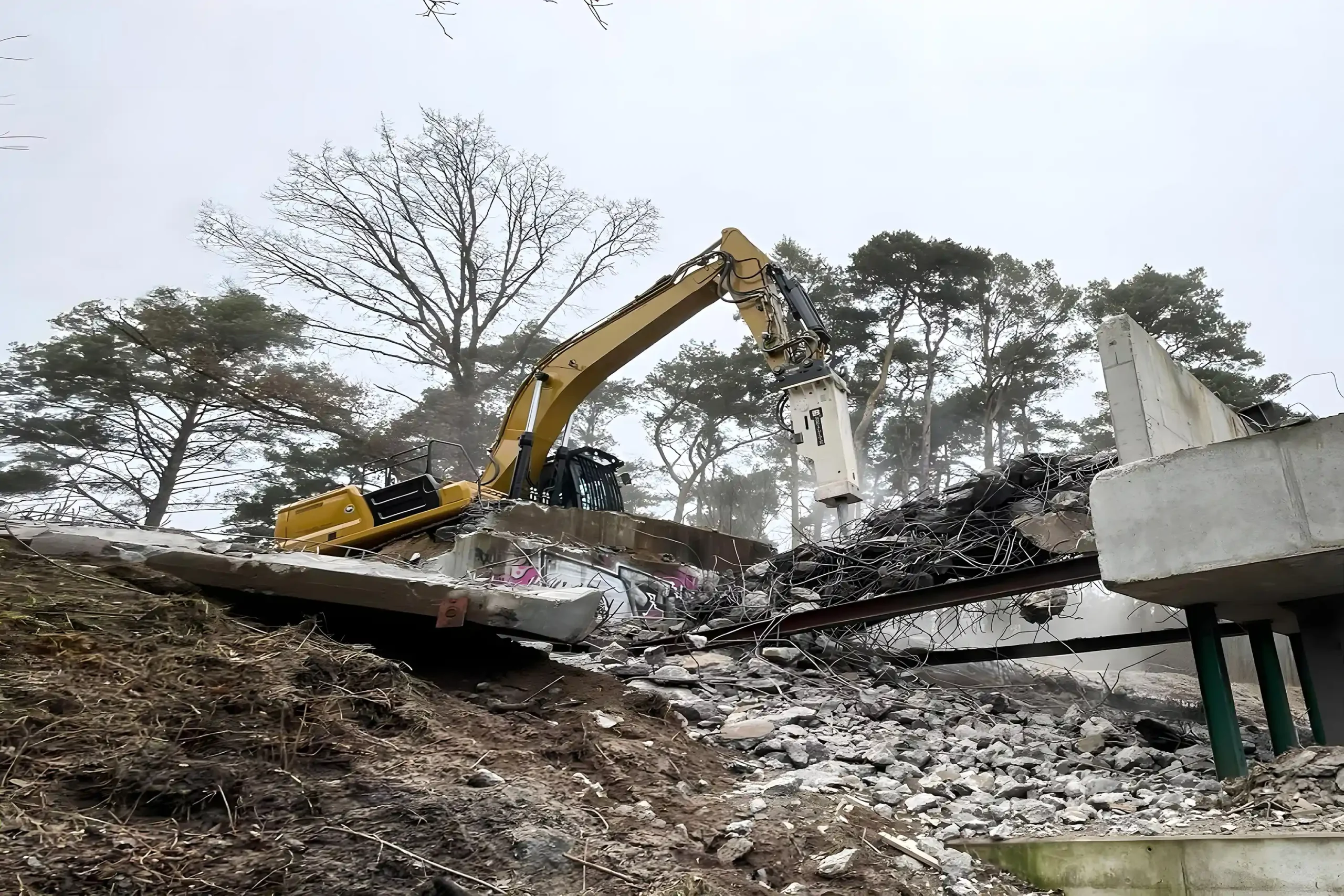
For practical applications of hydraulic breaking technology in construction, 《Hydraulic Breaker Hammer for Demolition&Rock Breaking》 covers real-world implementation details.
What Actually Happens When a Hydraulic Press Meets Diamond
The interaction between a hydraulic press and a diamond depends heavily on geometry and force distribution. Pure compressive loading, applied uniformly, tests the diamond’s bulk compressive strength. Under these conditions, the stone resists crushing up to pressures that exceed what most industrial presses can generate.
The situation changes when force concentrates at specific points or aligns with cleavage planes. Diamonds do not pulverize under pressure the way sofite materials do. They fracture along crystallographic planes where bonds are weakest. A hydraulic press that applies force through a pointed anvil or catches the diamond at an unfavorable angle can cause brittle fracture at pressures well below the theoretical compressive limit.
| Material | Mohs Hardness | Compressive Strength (GPa) | Fracture Toughness (MPa·m½) |
|---|---|---|---|
| Diamond | 10 | 60–100 | 3.4–5.3 |
| Tungsten Carbide | 9 | 4.5–7.0 | 8–10 |
| Steel (Hardened) | 7–8 | 1.5–2.5 | 50–100 |
| Granite | 6–7 | 0.15–0.25 | 1.5–2.5 |
The fracture toughness column tells an interesting story. Diamond’s value sits lower than hardened steel despite being far harder. This reflects the brittleness that makes diamonds splittable along cleavage planes while steel deforms plastically before failing.
Measuring Diamond’s True Limits Under Extreme Pressure
Researchers use diamond anvil cells to test materials at pressures exceeding anything found in industrial settings. These devices press two gem-quality diamonds together with a tiny sample between them, reaching pressures above 300 GPa. The irony of using diamonds to test diamonds is not lost on materials scientists.
Testing reveals that diamonds maintain structural integrity under uniform compression up to extraordinary pressures. The challenge in measuring ultimate tensile strength comes from the brittleness problem. Diamonds do not stretch before breaking. They simply fracture. Compressive yield strength provides more useful data for engineering applications. These measurements inform the development of superhard materials and guide decisions about where natural or synthetic diamonds can perform reliably in industrial tools.
Hydraulic Power in Rock Breaking and Demolition
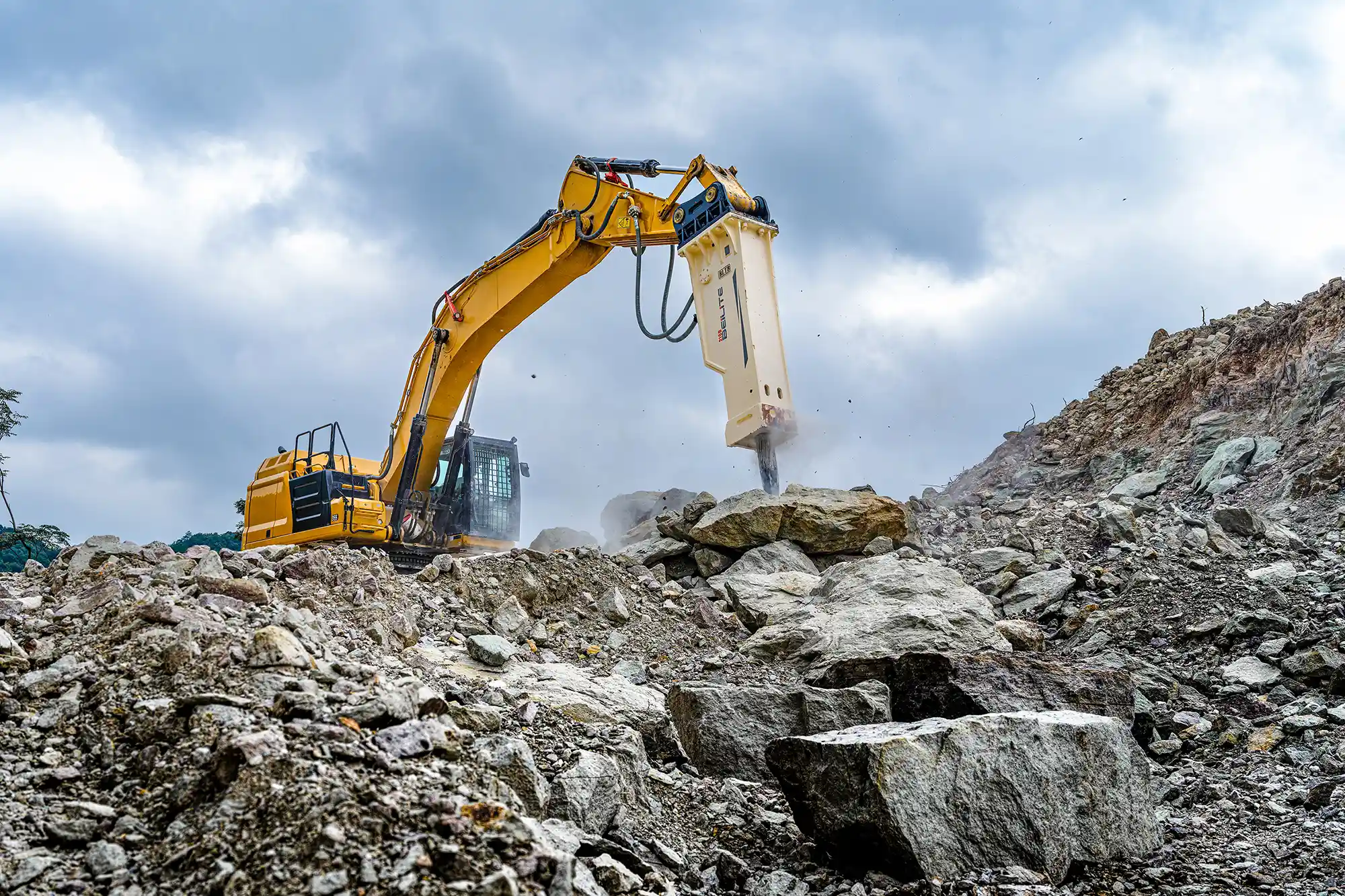
High-pressure hydraulic systems find their practical home in applications far removed from hypothetical diamond crushing. BEILITE’s hydraulic breakers serve mining operations, quarries, and demolition sites where breaking rock and concrete demands reliable force delivery over thousands of operating hours.
Focus on Hydraulic Breaker Hammer for Mining and Quarrying to improve efficiency in extraction operations. The equipment handles granite, basite, and reinforced concrete with impact energy calibrated to the material and excavator class. Similarly, Hydraulic Breaker Hammer for Demolition&Rock Breaking supports urban redevelopment projects where controlled breaking matters as much as raw power.
Synthetic Diamonds Engineered for Industrial Punishment
Industrial diamonds differ from gem stones in ways that matter for durability under working conditions. High-Pressure/High-Temperature synthesis and Chemical Vapor Deposition allow manufacturers to control crystal structure, inclusion density, and thermal properties. The resulting stones often outperform natural diamonds in specific applications.
A synthetic diamond grown for cutting tools might sacrifice optical clarity for enhanced toughness. One designed for heat sinks prioritizes thermal conductivity over hardness. This engineering flexibility makes synthetic production essential for modern manufacturing. Saw blades, grinding wheels, and wire drawing dies all depend on industrial diamonds optimized for their particular stress environments rather than the random properties of mined stones.
Frequently Asked Questions About Diamonds and Hydraulic Forces
Can a hydraulic press crush any material?
Hydraulic presses have upper limits determined by cylinder size, pump capacity, and structural strength of the press frame itself. Most industrial presses top out well below the pressures needed to overcome diamond’s compressive strength through uniform loading. The press can crush the vast majority of materials encountered in manufacturing and construction, but materials engineered for extreme hardness may survive if force distribution works in their favor.
What force is required to break a diamond?
The force required varies dramatically based on application method. Uniform compression might require pressures exceeding 100 GPa. A sharp impact along a cleavage plane can split a diamond with far less energy. Gem cutters routinely cleave diamonds using precise strikes that would seem impossibly weak compared to the stone’s reputation. The distinction between crushing and cleaving explains why diamonds can seem both invincible and fragile depending on circumstances.
Are industrial diamonds different from natural diamonds in strength?
Industrial diamonds produced through HPHT or CVD processes can be engineered with specific mechanical properties. Some synthetic diamonds exhibit greater toughness than typical natural stones because manufacturers control inclusion density and crystal orientation. Natural diamonds vary considerably in quality, with internal flaws that create weak points. A well-made synthetic diamond designed for industrial use often outperforms a natural stone in demanding applications where consistent performance matters more than geological origin.
Discover Advanced Hydraulic Solutions
BEILITE Machinery Co., LTD has developed high-performance hydraulic breakers since 2002, with BLT and BLTB brand products operating in demanding conditions across global markets. Our engineering team focuses on reliability and efficiency for mining, quarrying, and demolition applications. Contact us at [email protected] or call 40008-40008 for consultation on hydraulic breaking solutions matched to your operational requirements.